
Commuter shuttle services for businesses: fixed routes, real day rates, and when a shuttle beats a subsidy
A commuter shuttle gets your employees from home, a transit hub, or a park-and-ride lot to the office on a fixed route and schedule, paid for by the company. It’s one of two ways an employer can take on the commute problem: run a private shuttle, or hand employees a commuter subsidy and leave them to get to work on their own.
By Glenn Orloff, Metropolitan Shuttle · September, 2026
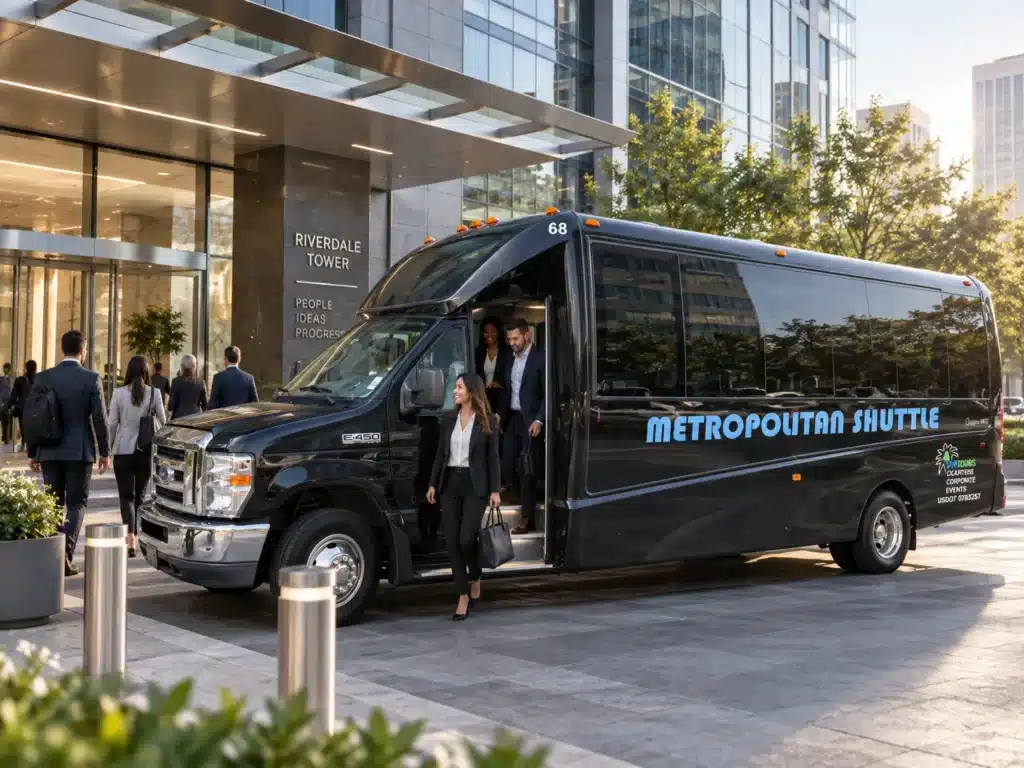
This page is about the first, when it’s the right answer, how the routes and schedules work, and what you’ll actually pay. Run well, a shuttle thins out your parking demand, shortens door-to-desk commutes, and gives recruiting a line that actually means something to candidates. A perfect example of how a shuttle can run well for commuters is our current project in Orlando. Metropolitan Shuttle runs a shuttle between the downtown Sunrail station, the Grove Parking Lot and our client’s office on Church Street from 6:30 AM – 9:30 AM and 3:30 PM – 6:30 PM.
Key takeaways
Fixed Commuter Shuttle Routes
Commuter shuttles run on fixed weekday routes anchored to transit stations or park-and-ride lots, timed to a morning peak in and an evening peak out.
Recurring Route Pricing
A recurring commuter route is priced individually as a day rate per vehicle, significantly below one-off charter rates, because charter pricing assumes a vehicle that sits idle half the time and a contracted daily route breaks that paradigm. For a floor check, the Federal Transit Administration’s National Transit Database put commuter bus operating cost at $262.94 per vehicle revenue hour in 2023.
Shuttle vs. Commuter Subsidies
The alternative to a shuttle is a commuter subsidy, and the honest dividing line is whether transit actually reaches your site: a subsidy helps employees pay for a commute that already works, while a shuttle creates one where transit, parking, or shift hours have failed.
Vetted Operators & Coverage
Metropolitan Shuttle has arranged group transportation since 2001 as a transportation management company, which means we vet and dispatch local operators rather than running a single fixed fleet, and we back every job with a $5 million umbrella on top of the $5 million each network operator carries.
What is a commuter shuttle service for businesses?
A commuter shuttle service moves your employees between home-area pickup points and your worksite on a recurring, scheduled basis, paid for by the employer. It’s the home-to-work leg specifically, which sets it apart from the other programs in this cluster: a corporate campus shuttle moves people between buildings and lots once they’ve arrived, and a shift worker shuttle covers the odd-hour runs that transit and rideshare tend to abandon at 2 a.m.
Most commuter programs fall into one of two shapes. The first is a hub feeder, where a bus meets a commuter rail station or subway stop and closes the “last mile” to an office park that transit doesn’t reach. The second is a direct residential run, where the bus loops through a few dense neighborhoods or a park-and-ride and drives straight to the office. If you’re new to the category and want the wider view of what an employee shuttle program includes, start with the employee shuttle services overview.
How do you plan routes and schedules for a commuter shuttle?
Start from where your people actually live, not from where the road looks convenient on a map. Pull home ZIP codes from HR (anonymized is fine) and look for clusters. Three or four pickup points that each serve a knot of employees beat a dozen scattered stops that add 20 minutes of dwell time to every run.
A few things decide whether the schedule sticks:
- Anchor to a transit hub or a park-and-ride. A single well-placed stop at a rail station or a large lot pulls riders from a wide radius without needing a stop on every block.
- Time to the peaks, not the clock. Run enough capacity to land people 10 to 15 minutes before shift start, and stage the evening departures around real quitting time. One bus doing a 7:15 and an 8:15 arrival covers most 9-to-5 offices.
- Cap the ride at what people will tolerate. Roughly 35 to 45 minutes door-to-office is the ceiling most commuters accept before they go back to driving. If a route runs longer, split it.
- Right-size the vehicle to the load. A full-size charter bus seats a crowd, but a mini-coach or 15-passenger van is cheaper to run for a thin route. Buying more seats than you fill is the fastest way to blow the budget.
For off-peak or around-the-clock coverage, the planning math changes, and that’s the shift worker shuttle conversation, not this one.
What does a commuter shuttle cost, and how is it priced?
A shuttle bills for vehicle and driver time, never per rider. There is no per-head pricing in this business, because the operator’s cost is the vehicle and the driver’s shift regardless of how many seats fill, and any quote structured otherwise is just vehicle time with a markup hidden inside arithmetic you can’t audit. For a recurring program, that vehicle time is priced individually as a day rate per vehicle, and it comes in significantly below one-off charter rates for a structural reason: charter pricing is built for an industry where a vehicle sits in the yard roughly half the time, so every charter hour has to carry the idle hours around it, and a contracted daily route breaks that paradigm. Your budget is the day rate times your service days, one predictable number, and when ridership grows you add a run rather than renegotiating a rate. The actual figures we bill, from more than 6,800 recurring invoices, are published on our employee shuttle cost page.
For a sanity check on the raw operating cost underneath any model, the Federal Transit Administration’s National Transit Database reported a national weighted-average operating expense of $181.88 per vehicle revenue hour for fixed-route bus service in 2023, and $262.94 per vehicle revenue hour specifically for commuter bus. Those are agency figures, not charter quotes, but they tell you a shuttle priced far below that floor is cutting a corner somewhere, usually on insurance or driver pay.
Should you run a shuttle or just subsidize the commute?
This is the real decision, and the honest answer depends on whether a commute your employees can use already exists. A commuter subsidy, typically a pre-tax transit benefit of up to $340 per employee per month under the IRS rules in 2026, is the right tool when transit genuinely reaches your site: it helps people pay for a commute that already works, it’s simple to administer, and several cities require employers above certain headcounts to offer something like it. What a subsidy cannot do is fix a commute that doesn’t exist. If your facility sits a mile past the last stop, if your shifts turn over before the first train runs, or if your parking is full and there’s nothing to subsidize people toward, no stipend solves that; a route does. That is the case where employers run a private shuttle, and it’s the service this page describes. The two aren’t mutually exclusive, either: some employers pair a transit subsidy for the workers transit serves with a shuttle for the site or shift it doesn’t. Confirm the tax treatment of whichever benefit you offer with your own advisor.
What rules apply to commuter shuttle operators?
For-hire passenger carriers crossing state lines have to register with the FMCSA and comply with its commercial regulations. FMCSA’s guidance on employer-related transportation is clear that payment isn’t always obvious: transportation is still for-hire when the cost is bundled into a larger package or paid indirectly. So an employer that hires a carrier to run its commute is squarely inside the regulated category.
The requirements that matter for a commuter program include FMCSA operating authority, minimum insurance levels, random drug and alcohol testing, valid commercial driver licensing, hours-of-service limits to keep tired drivers off the road, and regular vehicle inspection and maintenance. Accessibility is a legal line too: under the ADA rules in 49 CFR Part 37, private shuttle and over-the-road bus operators have to provide accessible service, with demand-responsive charter operators required to supply an accessible bus on 48-hour advance notice.
This is the part of the job that a transportation management company earns its keep on. We hold a GSA Schedule contract and have vetted operators across the United States and Canada since 2001, so the credential-checking, insurance verification, and dispatch happen before a bus ever shows up at your first stop. You get one point of contact instead of chasing individual carriers.
How do you get a commuter shuttle program running?
Bring three things to the first conversation: employee home clusters, your target arrival times, and how many people you expect to ride. From there we can size vehicles, sketch routes, and get you a same-day estimate. If you’re running a formal procurement, the employee shuttle RFP guide for HR teams walks through what to put in the request so the bids you get back are actually comparable.
Get a quote or call 866-556-3545. We take credit cards, checks, and wires.
Frequently Asked Questions
Request a Quote for Employee Shuttle Services