By Glenn Orloff, CEO, Metropolitan Shuttle
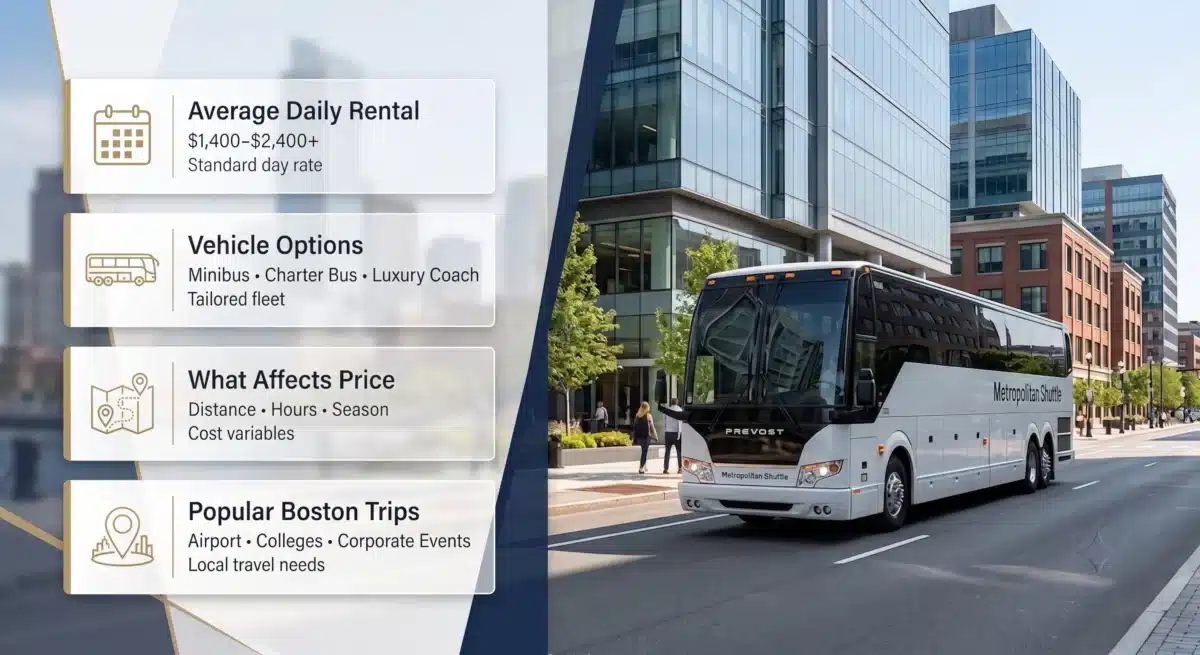
A full-size charter bus in Boston costs $185 to $320 per hour or $2,000 to $3,200 per day in 2026 through Metropolitan Shuttle, with minibuses running $165 to $240 per hour. Boston sits 10 to 25 percent above the national baseline, and that premium is not padding. It reflects real operating conditions we price into every quote: routing restrictions, tunnel tolls, scarce bus parking, and some of the tightest seasonal demand in the country.
We have been quoting Boston trips since 2001, from Logan Airport transfers to multi-day New England tours. What follows is how the number is actually built, so you can budget before you ever pick up the phone. You may visit our Boston charter bus page if you are ready to book right away.
Key takeaways
- A 52 to 56-passenger charter bus in Boston runs $185 to $320 per hour or $2,000 to $3,200 per day in 2026. A minibus (18 to 35 seats) runs $165 to $240 per hour.
- Boston is a Tier 1 pricing market alongside New York, San Francisco, and Washington DC, typically 10 to 25 percent above national baseline rates.
- Buses are prohibited on Storrow Drive and Memorial Drive due to low overpasses, which adds routing time that hourly quotes must absorb.
- May and early June are the most expensive weeks of the year. Greater Boston’s 50 plus colleges hold commencements within the same three-week window, and bus supply gets tight months in advance.
- A full bus is one of the cheapest per-person options in the city: a $2,400 corporate charter split across 50 passengers is $48 a head, round trip, with a professional driver.
- Tolls, parking, and driver lodging on overnight trips sit on top of the base rate. Ask for an itemized quote so nothing surprises you on the invoice.
What are typical charter bus rates in Boston?
These are planning ranges for the Boston metro in 2026, built from our published national charter bus pricing plus the Boston market premium. Your exact figure depends on date, itinerary, and how tight supply is when you book.
| Vehicle | Seats | Per hour | Per day |
|---|---|---|---|
| Charter bus | 52-56 | $185-$320 | $2,000-$3,200 |
| Executive coach | 30-40 | $220-$390 | $2,400-$3,900 |
| Minibus | 18-35 | $165-$240 | $1,700-$2,300 |
| Sprinter van | 12-14 | $140-$190 | $1,200-$1,900 |
| School bus | 42-72 | $135-$175 | $1,100-$1,500 |
Rates last reviewed July 2026. Hourly billing applies to local trips, usually with a 4 to 5 hour minimum. Full-day and multi-day trips shift to daily pricing.
Treat these as budget baselines, not final numbers. The only figure worth planning against is an itemized quote for your specific trip. You can request one here or call (617) 712-0019.
Why does Boston cost more than the national average?
Four reasons, and each one shows up in the quote whether or not it appears as a line item.
Routing restrictions. Buses cannot use Storrow Drive or Memorial Drive. The overpasses were built for 1930s automobiles, with clearances around ten feet. Every Boston driver knows the wreckage that greets a truck that tries anyway. For a charter, this means the direct route along the Charles is off the table, and the legal route through city streets or the Pike takes longer. Time is the billing unit, so the detour is in the price.
Tolls and tunnels. The Sumner, Callahan, and Ted Williams tunnels and the Mass Pike all carry tolls, and commercial vehicles pay more than cars. A Logan run means tunnel tolls in at least one direction every time.
Parking scarcity. A 45-foot coach cannot circle the block in the Financial District while your group finishes dinner. Legal bus staging in central Boston is limited, and where paid options exist, they cost real money. On longer city days, the driver may need to stage outside the core and return for pickup, which adds clock time.
Seasonal demand. Boston’s calendar has demand spikes most cities do not have. Commencement season across Harvard, MIT, BU, BC, Northeastern, Tufts, and dozens of other schools compresses enormous demand into May and early June. Add Marathon Monday in April, Fenway’s 81 home dates, and fall campus move-ins, and there are weeks when every coach in New England is spoken for.
What do real Boston trips actually cost?
Representative ranges from the kinds of trips we quote most often. Your specifics will move the number, but this is the honest neighborhood.
| Trip | Details | Typical range |
|---|---|---|
| Logan Airport transfer | 25 passengers, one-way to a Back Bay hotel | $500-$750 |
| Corporate event day | 50 employees, 8 hours, Seaport / BCEC with multiple stops | $2,400-$3,100 |
| Wedding shuttle | 40 guests, ceremony to reception, 4 to 5 hours | $850-$1,400 |
| University athletics trip | 45 passengers, round trip to Gillette Stadium | $1,600-$2,200 |
| School field trip | Full day, museum circuit, school bus | $1,100-$1,500 |
| Multi-day New England tour | 50 passengers, 3 days, Boston to Maine coast | $6,000-$9,000 |
Two notes from experience. First, one-way trips cost more per mile than round trips because the bus still has to return to its depot empty, and those miles are in the price. Second, on multi-day trips, federal Hours of Service rules cap a driver at 10 hours of driving in a 15-hour duty window, so overnight itineraries include driver lodging. Neither of these is a Boston quirk, but both catch first-time bookers.
What is included in the rate, and what costs extra?
The quote covers the vehicle, the professional driver, fuel, and insurance. Every vehicle in our Boston network meets or exceeds FMCSA safety requirements and carries a minimum of $5 million in liability coverage, with our additional $6 million umbrella on top.
What sits outside the base rate: tolls, parking fees, driver meals and lodging on overnight trips, gratuity, and overtime if the day runs past the booked window. None of this should be a surprise. Our quotes are itemized, and my standing advice to any procurement officer is simple: get every exclusion in writing before you sign, from us or from anyone else.
How can you keep the cost down without cutting quality?
Right-size the vehicle first. Booking a 56-seat coach for 30 people is the single most common way Boston groups overpay. You pay for the unit, not the headcount, and a half-empty coach is money spent on air. Finalize your count, then match the vehicle.
Then work the calendar. Weekday trips typically run 10 to 20 percent below weekend rates. If your dates are flexible, avoid the commencement crunch entirely. If they are not flexible, and for a graduation they never are, book three to six months out. For ordinary trips, four to eight weeks ahead secures the right vehicle at the best rate.
Finally, structure round trips where you can, and choose pickup points that do not force the bus through the most congested blocks at the worst hour. A 7:30 am pickup in Kendall Square is a different trip than the same pickup at 8:30.
For recurring routes rather than one-off events, the math changes in your favor. Our Boston employee shuttle services are priced on committed schedules, and the effective daily rate drops with commitment. Corporate groups running regular programs should start with our Boston corporate bus rentals page; schools and universities have their own dedicated charter options.
When should you book a charter bus in Boston?
Four to eight weeks ahead for most trips. Three to six months for anything touching commencement season, Marathon Monday, or a major convention at the BCEC. Boston bus supply is finite, and on peak dates the question stops being price and becomes availability. The groups that book early get the right vehicle at a fair rate. The groups that call two weeks before a May graduation get whatever is left, at whatever it costs.
Planning the itinerary itself, not just the transportation? Our three-day Boston itinerary covers the ground a visiting group can realistically cover, and it pairs well with a coach and a driver who knows which streets a bus can actually use.
Frequently asked questions
How much does it cost to rent a charter bus in Boston for a day?
Plan on $2,000 to $3,200 for a full-size 52 to 56-passenger charter bus, or $1,700 to $2,300 for a minibus, for a full day in 2026. Tolls, parking, and driver lodging on overnight trips are billed on top of the daily rate.
Hourly rates run $185 to $320 for a full-size coach, $165 to $240 for a minibus, and $140 to $190 for a sprinter van, usually with a 4 to 5 hour minimum on local trips.
Boston is a Tier 1 pricing market. Bus prohibitions on Storrow and Memorial Drive force longer routes, the harbor tunnels and Mass Pike carry commercial tolls, legal bus parking downtown is scarce, and commencement season concentrates a year’s worth of demand into a few weeks of May and June.
Four to eight weeks for most trips. Three to six months for commencement season, Marathon Monday, or major BCEC convention dates when regional bus supply sells out well in advance.
Almost always, once the group passes about 15 people. Moving 50 people from a Seaport hotel to a Cambridge venue by rideshare means a dozen or more cars each way at surge-prone rates. A $2,400 charter works out to $48 per person for the whole day, with everyone arriving together and one invoice at the end.
Ready for a real number instead of a range? Get a custom Boston quote or call (617) 712-0019. One call, one point of contact, and an itemized price built to hold. See our full Boston charter bus services for everything we run in the city.
Glenn Orloff — Founder & CEO, Metropolitan Shuttle
Glenn Orloff is the founder and CEO of Metropolitan Shuttle, a nationwide group ground transportation company he built from a single idea in 2001 into a network spanning hundreds of markets across the United States and Canada. Before launching the company, he spent twelve years as a financial executive—including postings in Tokyo and Moscow—where he learned that logistics, trust, and accountability look the same in any language. That background shapes how Metropolitan Shuttle operates: analytically, transparently, and with a bias toward solving problems rather than selling services. Glenn writes about group transportation, fleet logistics, and the operational realities of moving people at scale.