By Glenn Orloff, CEO, Metropolitan Shuttle
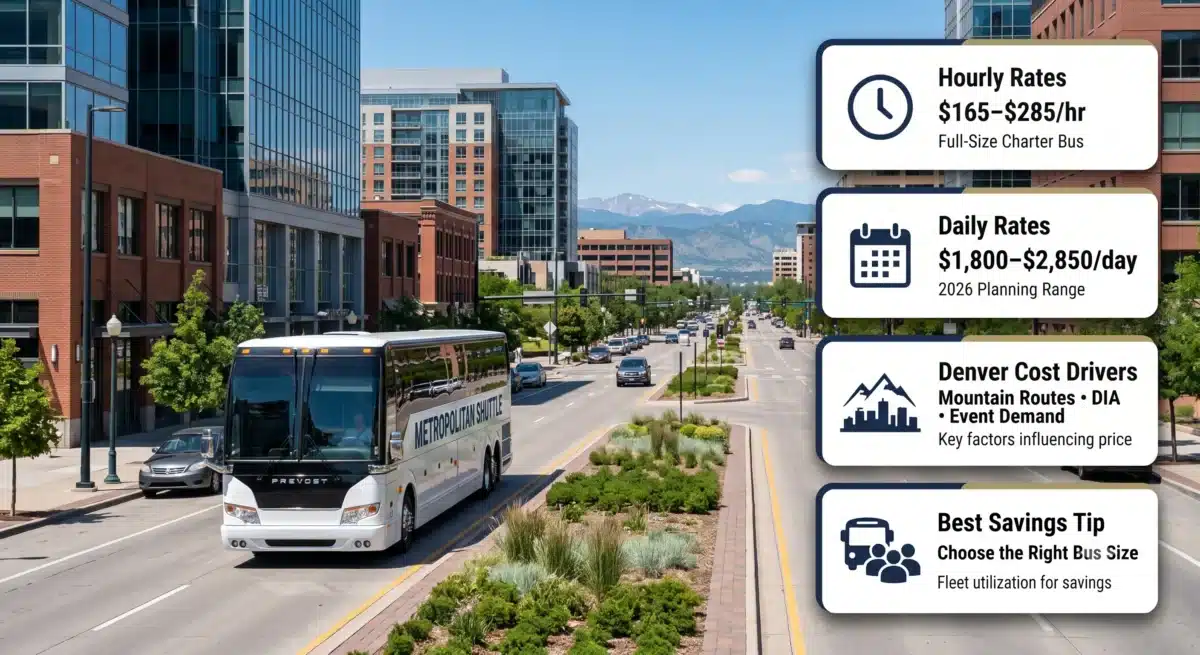
A full-size charter bus in Denver costs $165 to $285 an hour or $1,800 to $2,850 a day in 2026, with minibuses running $150 to $200 an hour and sprinter vans starting around $125. Those are real planning numbers based on actual trips provided by Metropolitan Shuttle in 2026. What follows is how the final figure gets built, because in Denver and the surrounding areas, the calendar, the mountains, and the airport all impact pricing.
I have been quoting these trips since 2001. Denver is one of the most fun charter markets in the country, but it punishes people who book late for the wrong weekend. You may visit our Denver charter bus page for detailed booking information, or our charter bus pricing guide for additional pricing information, but here is what you need to know about pricing.
Key takeaways
- A standard 52 to 56-passenger charter bus in Denver runs $165 to $285 per hour or $1,800 to $2,850 per day in 2026, with a five-hour minimum of hourly work.
- Denver sits in the moderate pricing tier nationally, cheaper per hour than New York, San Francisco, or Chicago, with better vehicle availability than most mountain-state markets.
- Mountain trips on the I-70 corridor are priced by the mile or the day, not the hour, and federal driver-hour limits often add an overnight or a second driver to the cost.
- Deadhead mileage, the empty miles a bus drives to reach you, is why a one-way DIA transfer can cost more than the 50 miles on the map suggest.
- The single most common way Denver groups overpay is booking a 56-seat coach for 30 people; right-sizing the vehicle saves more than negotiating the rate ever will.
- Red Rocks concert nights, Coors Field series, and convention weeks compress local bus supply, so fixed-date event trips should be booked three to six months out.
How much does a charter bus cost in Denver in 2026?
Plan on the ranges below. Denver pricing typically lands in the middle of national ranges: the market has healthy vehicle supply and none of the congestion tolls or parking scarcity that push New York and San Francisco rates 10 to 25 percent higher. These are planning baselines drawn from our published charter bus pricing guide; your exact figure depends on date, itinerary, and how tight supply is that week.
| Vehicle type | Seats | Per hour | Per day | Per mile |
|---|---|---|---|---|
| Charter bus | 52-56 | $165-$285 | $1,800-$2,850 | $4.00-$6.00 |
| Executive coach | 30-40 | $200-$350 | $2,200-$3,500 | $5.00-$7.00 |
| Minibus | 18-35 | $150-$200 | $1,500-$1,900 | $3.00-$5.00 |
| Sprinter van | 12-14 | $125-$160 | $1,100-$1,700 | $1.50-$3.00 |
| School bus | 42-72 | $120-$145 | $950-$1,250 | $2.50-$3.50 |
A concrete Denver example from our own quote history: a 20-guest brewery tour, five hours with four stops, runs $750 to $1,000 on a minibus. That is the shape of most local Denver work, an hourly rate times a five-hour minimum, plus whatever parking the itinerary requires.
If you want a real number instead of a range, contact us for an immediate quote. One call, one point of contact, and an itemized figure you can actually budget against.
How is the price calculated: hourly, daily, or by the mile?
The billing model follows the trip, and picking the wrong one is how quotes get misread. Short local work, a wedding shuttle, a corporate transfer, a downtown event loop are billed hourly with a four to five-hour minimum. Full-day and multi-day trips, a retreat in Estes Park, or a weekend tournament are billed by the day. Long-distance runs where the dominant cost is road time, a team trip to Salt Lake City, for example, are billed by the mile at roughly $4 to $6 for a full coach.
The practical rule: a short trip over a long time is priced by the hour, a long distance in a short time is priced by the mile, and anything spanning days is priced by the day. Our Denver charter bus page covers the local service area in detail if you are still scoping the trip.
Why does the date change the price so much in Denver?
Because Denver’s event calendar compresses bus supply harder than most other comparable markets. There are only so many coaches based along the Front Range, and on certain dates most of them are already committed.
Red Rocks runs shows nearly every night from spring through fall, and each one pulls shuttle vehicles toward Morrison. Coors Field hosts 81 Rockies home games plus one-off events; this summer alone the calendar includes AC/DC at Empower Field on July 28, the Savannah Bananas at Coors Field on August 14 and 15, and My Chemical Romance at Coors Field on August 27. Add graduation season at CU Boulder, DU, and Colorado State in May, convention weeks downtown, and winter ski charters on I-70, and you get what I call demand compression: the same bus, the same route, priced 20 to 40 percent apart depending on what else is happening that day.
Two rules to follow from this. First, a weekday trip in the off-season can sit well under a peak-Saturday quote for the identical vehicle, typically 10 to 20 percent under. Second, if your date is fixed a conference, a wedding, or a graduation ceremony, it is recommended to book three to six months before. Last-minute availability in this market is not a discount opportunity. It is usually a choice between paying a premium and not getting a bus at all.
What is deadhead mileage, and why does DIA make it matter?
Deadhead is the empty miles a bus drives to reach your pickup and to return to its depot after drop-off. You pay for it because the operator pays for it: fuel, driver time, and wear accrue whether or not anyone is in the seats.
Denver International Airport makes this concrete. DIA sits roughly 25 miles from downtown, farther than almost any major American airport from its city center. A one-way airport transfer involves the bus driving out, carrying your group in, and returning empty, so the invoice reflects closer to 50 miles of vehicle movement than 25. This is why one-way trips rarely cost as little as people expect, and why round trips usually price better per mile: the operator can plan a complete loop and put the vehicle back to work.
Book round trips where you can, and pick staging points near where buses are actually based rather than at the far edge of the metro.
How do driver hours affect mountain trips?
They set a hard legal ceiling, and the mountains eat that ceiling fast. Under the federal Hours of Service rules enforced by the FMCSA, a passenger-carrying driver may drive no more than 10 hours after eight consecutive hours off, and may not drive at all after 15 hours on duty. These are not guidelines; violations carry civil penalties in the five figures.
Now run a real Denver itinerary against that limit. A day trip to Breckenridge or Vail is two to three hours each way when I-70 behaves, and I-70 frequently does not. Winter chain laws, weekend ski traffic, and summer construction can turn a 100-mile leg into a four-hour drive. A 7 a.m. departure with an evening return can push a driver against the 15-hour duty window even though the group only skied for six hours.
When a trip exceeds the window, you have two choices, and each has a price. Overnight the driver: the bus stops, the driver takes the required rest, and you cover lodging, typically a couple hundred dollars a night. Or send a second driver, which keeps the coach moving but means paying two professionals. My plain advice after two decades: do not pay for a second driver to save a hotel room. If your group is sleeping in Vail, the bus can sleep in Vail too. Reserve the second driver for schedules that truly cannot stop.
What extra costs should Denver renters expect on top of the base rate?
The quote covers the vehicle and the driver. The trip covers the rest, and the honest move is to get the rest in writing before you sign. In the Denver market, the recurring extras are these: E-470 and Northwest Parkway tolls if your route uses them, event and stadium parking (Coors Field and Empower Field both charge buses, and Red Rocks lots fill early on show nights), driver meals and lodging on multi-day trips, a customary 15 to 20 percent service fee, and overtime if your event runs past the contracted window.
One more that planners forget: standby service. If you need the bus to wait on site during a six-hour event rather than release and return, you are paying for that time, because the vehicle and driver cannot take other work. Sometimes standby is worth it, an executive group with an uncertain end time should have the bus sitting there. Sometimes a scheduled return saves several hundred dollars. Decide deliberately rather than by default.
For recurring routes rather than one-off events, the math changes entirely. Our Denver employee shuttle services are priced on committed schedules, and the per-day cost drops well below single-charter rates.
How do you lower the cost without lowering the quality?
Right-size the vehicle first, and I will state this against the common advice: chasing a lower hourly rate is the least effective way to cut a charter bill. Booking a 56-seat coach for a 30-person group “to be safe” is the single most common way Denver groups waste a thousand dollars, because a bus is priced as a unit, not per head. Finalize your count, then match the vehicle. Our overview of charter bus types covers capacity by vehicle, and if you are torn between a minibus and a full coach, our minibus versus motorcoach comparison settles it in five minutes.
After that, the levers rank in this order for the Denver market. Book early, four to eight weeks for routine trips, three to six months for fixed-date peak events. Travel midweek when the itinerary allows; the 10 to 20 percent weekend premium is real. Structure round trips to avoid paying full deadhead on an empty return leg. Skip amenities you will not use on short runs; Wi-Fi matters on a Vail transfer, not on a 20-minute downtown shuttle. And on multi-day trips, ask whether daily pricing beats stacking hourly days, because past about eight billed hours it almost always does.
What you should not do is take the lowest quote without reading what it excludes. The cheapest line item is frequently the most expensive trip, because the savings were borrowed from parking, lodging, or a second driver that reality will demand later. If you are planning the itinerary itself, our guides to Denver-area day trips and Denver’s hidden gems are a useful starting point.
Frequently asked questions
A full-size charter bus runs $1,800 to $2,850 per day in Denver in 2026, and a minibus $1,500 to $1,900. Daily pricing applies when the bus and driver stay dedicated to your group for a full day or longer. Parking, tolls, and driver lodging on overnight trips are billed on top of the daily rate.
A one-way group transfer between downtown Denver and DIA typically prices as a short hourly job against the vehicle minimum, so expect roughly $750 to $1,000 for a minibus depending on group size and time of day. The 25-mile distance and the empty return leg are why it costs more than the mileage alone suggests. Round-trip structures usually price better per mile.
Four to eight weeks for routine trips, and three to six months for fixed dates during peak windows: May graduations, summer concert season, ski weekends, and major conventions. Denver supply tightens fast around large events, and late booking means paying a premium or losing the date. See our charter bus pricing guide for the full timing breakdown.
A minibus is cheaper if your group fits in one, $150 to $200 per hour against $165 to $285 for a full coach, and the gap widens on daily rates. The deciding factor is headcount, not rate: 30 people on a 56-seat coach is paid-for empty space. Our charter bus rental guide walks through matching vehicle to group size.
Yes. A legitimate quote includes the professional driver, fuel, and vehicle insurance. What it may not include is tolls, parking, driver lodging on multi-day trips, and gratuity, so ask for an itemized quote in writing before you book.
Glenn Orloff — Founder & CEO, Metropolitan Shuttle
Glenn Orloff is the founder and CEO of Metropolitan Shuttle, a nationwide group ground transportation company he built from a single idea in 2001 into a network spanning hundreds of markets across the United States and Canada. Before launching the company, he spent twelve years as a financial executive—including postings in Tokyo and Moscow—where he learned that logistics, trust, and accountability look the same in any language. That background shapes how Metropolitan Shuttle operates: analytically, transparently, and with a bias toward solving problems rather than selling services. Glenn writes about group transportation, fleet logistics, and the operational realities of moving people at scale.