By Glenn Orloff, CEO, Metropolitan Shuttle
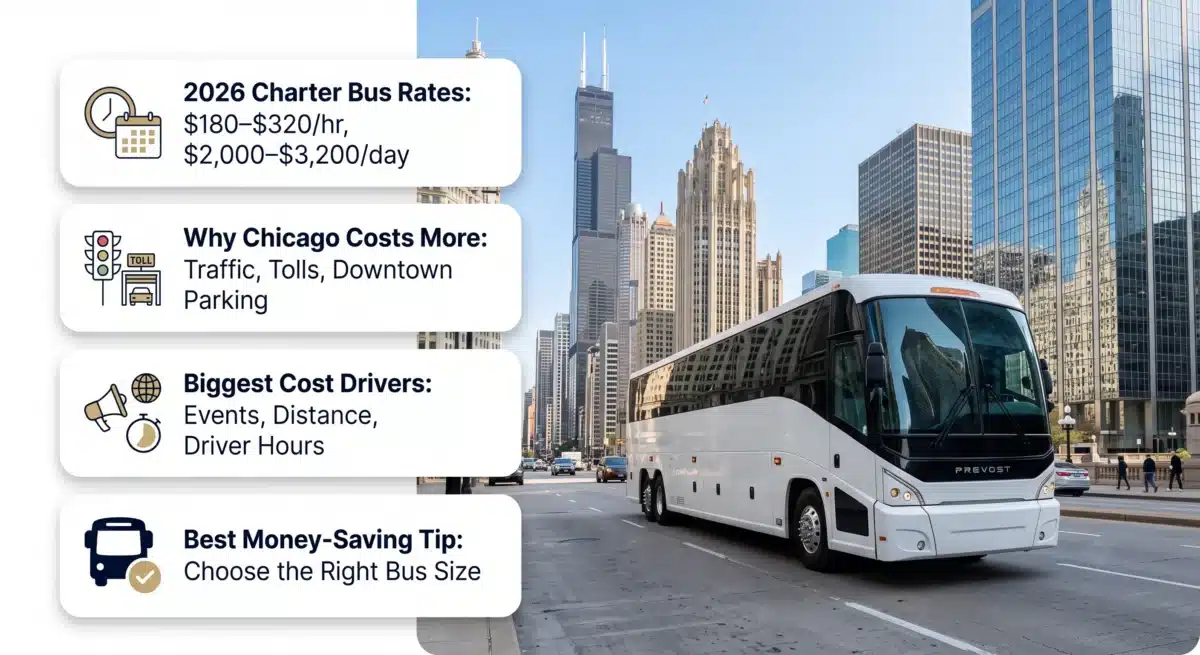
A full-size charter bus in Chicago costs $180 to $320 an hour or $2,000 to $3,200 a day in 2026, with a minibus running $160 to $230 an hour. At Metropolitan Shuttle, we provide charter bus services all over the country, and Chicago is one of the most expensive charter markets, typically 10 to 25 percent above the national baseline. What you actually pay is built from the vehicle, the calendar, the miles, and the hours a driver is legally allowed to work. I have been quoting these trips since 2001, so what follows is how the figure gets assembled in practice.
Key takeaways
- A standard 52 to 56-passenger charter bus in Chicago runs $180 to $320 per hour or $2,000 to $3,200 per day in 2026; minibuses run $160 to $230 per hour and sprinter vans $135 to $180.
- Chicago prices sit 10 to 25 percent above national rates because of traffic, tight downtown parking, toll costs, and heavy convention and event demand.
- Federal law caps a passenger driver at 10 hours of driving inside a 15 hour duty window, which is the real reason long trips carry an overnight or second-driver charge.
- Deadhead mileage, the empty miles a bus drives to reach you and return to its depot, is priced into every quote, and many Chicago coaches are based in the suburbs, not the Loop.
- Bus parking is a real line item downtown: McCormick Place charges about $35 a day for buses, and Soldier Field’s oversized-vehicle lot runs $160 on event days.
- The single most common way Chicago groups overpay is booking a 56-seat coach when 27 people would fit on a minibus.
How much does it cost to rent a charter bus in Chicago in 2026?
Plan on $180 to $320 an hour for a full-size coach, with a five hour minimum on local trips. These figures start from our published 2026 charter bus pricing guide, where the national baseline for a full coach is $165 to $285 an hour, adjusted upward for Chicago’s premium-tier costs. These should be treated as planning numbers. Your exact figure depends on the date, the itinerary, and how tight bus supply is that week, and an itemized quote is the only number you should budget against.
| Vehicle type | Seats | Per hour (Chicago) | Per day (Chicago) |
|---|---|---|---|
| Charter bus | 52-56 | $180-$320 | $2,000-$3,200 |
| Executive coach | 30-40 | $220-$390 | $2,400-$3,900 |
| Minibus | 18-35 | $160-$230 | $1,650-$2,100 |
| Sprinter van | 12-14 | $135-$180 | $1,200-$1,900 |
| School bus | 42-72 | $130-$165 | $1,050-$1,400 |
If you are not sure which vehicle fits your group, our breakdown of charter bus types walks through capacity and use case for each. And if you want a real number instead of a range, contact us for an immediate quote. One phone call, one point of contact, and you will have a figure you can actually put in a budget.
Why does Chicago cost more than the national average?
Because the cost of operating a bus hour in Chicago is higher than almost anywhere outside New York or San Francisco. Four things drive it.
First, congestion. A coach crossing the Loop at 5 p.m. burns driver time and fuel at a rate a Phoenix operator never sees, and billable hours reflect the clock, not the odometer. Second, tolls. Most itineraries touching O’Hare or the western suburbs ride the Illinois Tollway, and commercial vehicles pay multiples of the passenger-car rate. Third, parking scarcity. A 45-foot coach cannot circle the block while your group eats dinner in River North, so legal staging and paid bus parking get built into the plan. Fourth, demand. Between McCormick Place conventions, festival season, and two airports feeding group travel year round, Chicago buses stay busy, and busy fleets do not discount.
None of this is padding. It is the actual cost structure of the market, which is why a quote that ignores it should worry you rather than excite you.
How do trip length and mileage set the billing model?
Short local trips are billed by the hour, full and multi-day trips shift to a daily rate, and long-distance runs are priced by the mile. The practical rule: a short trip over a long day or less is priced by the hour, a long distance even in a short time is priced by the mile, and anything spanning days is priced by the day.
This matters for how you structure a request. A wedding shuttle looping between a Gold Coast hotel and a Bridgeport venue for five hours is hourly work. A three-day board retreat in Lake Geneva is daily work, and the per-day rate typically improves with each committed day because an operator can plan the vehicle’s whole week. A one-day run to South Bend and back is mileage-driven. If your event has a long midday gap, ask about standby versus drop-off/pick-up. Keeping a coach and driver on standby all afternoon costs money, but releasing the bus and bringing it back can cost more once you price the extra deadhead, so run both numbers before assuming.
For recurring routes rather than one-off events, pricing is done differently. Our Chicago employee shuttle services are priced on a program basis, and the per-day cost drops significantly with commitment.
What do driver hours and overnight trips add?
Federal Hours of Service rules cap a passenger-carrying driver at 10 hours of driving after eight consecutive hours off duty, inside a 15 hour on-duty window. These are not guidelines. They are enforced federal law with civil penalties, and no legitimate operator will schedule a violation.
For a single day inside that window, nothing changes on your invoice. For anything longer, you have two options with different pricing. You can overnight the driver, which means covering lodging, typically a couple hundred dollars a night. Or you can pay for a second driver to keep the coach moving through the night. My advice in most cases: do not pay for a second driver to save a hotel room. If your group is sleeping, the bus and driver can sleep too. Save the second driver for the rare trip where the schedule truly cannot stop.
What is deadhead mileage, and why is it on my Chicago quote?
Deadhead is the empty miles the bus drives to reach your pickup and to return to its depot with no passengers aboard. You pay for it because the operator pays for it, in fuel, driver time, and vehicle utilization, whether or not anyone is in the seats.
This bites harder in Chicago than people expect, because much of the region’s coach capacity is based in the suburbs rather than downtown. A bus staged in Elk Grove Village or Alsip may drive 45 minutes empty before your group ever boards in the Loop. It is also why one-way trips rarely cost as little as one might expect. If a coach takes your group to Milwaukee and drives home empty, that return leg is in the price. Round trips usually cost less per mile because the operator can plan a complete loop. If your itinerary is genuinely one-way, ask specifically how deadhead is calculated before you sign.
How do dates and events move Chicago prices?
More than any other single factor except vehicle size. Demand in this market compresses hard around a handful of predictable windows: Lollapalooza weekend, the Chicago Marathon, Bears home games, graduation season at the universities, and the large McCormick Place shows that can absorb dozens of coaches for shuttle work in a single week. Book a bus for a Saturday that overlaps one of these and you are competing with everyone else who needs one, at exactly the moment supply is thinnest.
The same mechanics work in reverse. A midweek trip in late January or early February can run 10 to 20 percent below the identical trip on a peak Saturday. And last-minute availability cuts both ways: occasionally an operator has an idle coach and will price it to move, but far more often a late booking means paying a premium for whatever is left. My honest recommendation is four to eight weeks of lead time for a normal trip and three to six months for a fixed-date event in a peak window. Our step-by-step booking guide for Chicago event planners walks through the full timeline.
What extra costs should you budget for beyond the base rate?
The quote covers the vehicle and the driver. The trip covers the rest, and in Chicago the rest is real money. Bus parking at McCormick Place runs about $35 a day, and Soldier Field’s oversized-vehicle parking in the Adler Lot is $160 plus a transaction fee on event days. Add Illinois Tollway charges for airport and suburban routes, driver lodging on overnight trips, and a customary service fee of 10 to 15 percent, and a $2,400 base quote can become a $2,900 trip.
None of these should surprise you, because all of them are knowable in advance. The fix is the same one I give every procurement officer who calls us: get an itemized quote and ask, in writing, what is not included. A company that hesitates to answer that question has told you something useful.
How can you keep the cost down without cutting quality?
Right-size the vehicle first. This runs against the instinct to book big to be safe, but booking a 56-seat coach for a 27-person group is the single most common way Chicago groups waste a thousand dollars. You are paying for a unit, not a headcount, and half a bus of empty seats is money spent on air. Finalize your passenger count, then match the vehicle. If you are torn between a minibus and a full coach, our comparison of minibus versus motorcoach amenities settles it in ten minutes.
Beyond that: book early, travel midweek when your event allows it, structure round trips rather than one-ways, choose pickup points near where buses are actually based when you have flexibility, and skip amenities you will not use on a 40-minute airport run. For executive moves where the amenities are the point, our Chicago corporate charter services cover that end of the market.
What you should not do is chase the lowest number without reading what it excludes. The cheapest line item is frequently the most expensive trip, because the savings were quietly borrowed from parking, lodging, or a second driver that will crop up later.
Frequently asked questions
A full-size charter bus costs $2,000 to $3,200 per day in Chicago in 2026, and a minibus runs $1,650 to $2,100. Daily pricing applies to full-day and multi-day trips where the bus and driver stay dedicated to your group. Parking, tolls, and driver lodging on overnight trips are billed on top of the daily rate.
Minibuses run $160 to $230 per hour in Chicago, and sprinter vans $135 to $180, usually with a four to five hour minimum. Specialty vehicles like party buses and executive coaches price higher because of their amenities. Our Chicago charter bus page covers the full local fleet.
Because of deadhead mileage, the empty miles the bus drives back to its depot after dropping you off. The operator pays for that return leg whether anyone is aboard or not, so it is priced into your quote. Round trips often cost less per mile because the vehicle can be scheduled as a complete loop.
Four to eight weeks ahead for most trips, and three to six months for fixed-date events during peak windows like Lollapalooza, the Chicago Marathon, or graduation season. Early booking secures the right vehicle at the best rate and protects you from last-minute premiums when local supply tightens.
The vehicle, the professional driver, fuel, and insurance are standard. Parking, tolls, driver lodging on multi-day trips, and gratuity typically sit on top of the base rate. Always request an itemized quote in writing so you know the full trip cost, not just the base rate, before you commit.
Glenn Orloff — Founder & CEO, Metropolitan Shuttle
Glenn Orloff is the founder and CEO of Metropolitan Shuttle, a nationwide group ground transportation company he built from a single idea in 2001 into a network spanning hundreds of markets across the United States and Canada. Before launching the company, he spent twelve years as a financial executive—including postings in Tokyo and Moscow—where he learned that logistics, trust, and accountability look the same in any language. That background shapes how Metropolitan Shuttle operates: analytically, transparently, and with a bias toward solving problems rather than selling services. Glenn writes about group transportation, fleet logistics, and the operational realities of moving people at scale.